Discover
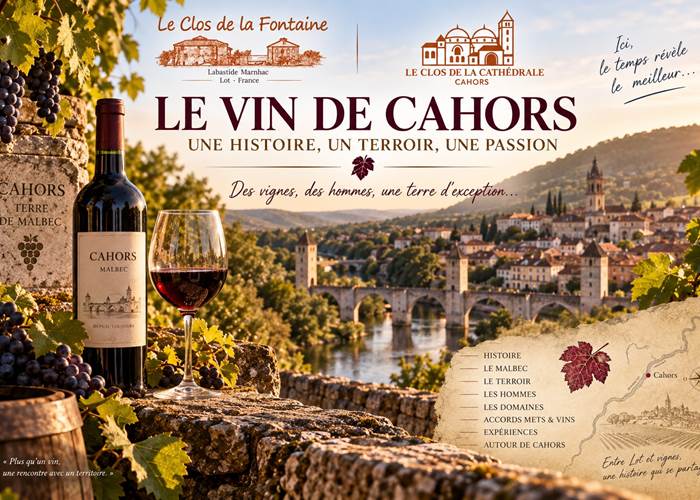
CAHORS WINE - A history, a terroir, a passion
Cahors Wine — A history, a terroir, a passion
In Cahors, in the heart of the Lot Valley , wine has been part of the landscape and history for centuries. Here reigns Malbec , the emblematic grape variety of the Cahors AOP , which draws its character from the terraces of the Lot Valley and the limestone plateaus of the Causses.
But Cahors wine is more than just a grape variety. It's a story of winemakers, trade, prosperity, crises, and rebirth. A wine once exported throughout Europe, historically known as "black wine," and which continues to build its reputation today.
From Le Clos de la Fontaine in Labastide-Marnhac and Le Clos de la Cathédrale in the heart of Cahors , we invite you to discover it: its history, Malbec, its terroirs, its estates and its winemakers, but also our good addresses and our advice to discover the vineyard of Cahors during your stay.
Because understanding Cahors also means understanding its wine.
Chapter 1: "The terroirs of Cahors wine: from the Lot to the limestone plateaus, the many faces of Malbec"
We often speak of Cahors wine. Yet, it would almost be more accurate to speak of Cahors wines . For behind the same grape variety, Malbec, lies an astonishing diversity of landscapes and soils. The Lot Valley has carved out a veritable natural staircase here, from the terraces near the river to the limestone plateaus of the Causses.
Over time, the Lot River deposited its alluvial deposits and carved its bed, leaving behind several levels of terraces. The first terrace is composed of relatively recent alluvium, while the second and third terraces rest on much older deposits. Higher up, above approximately 250 meters in altitude, lie the limestone terroirs of the Causses, with their often thinner and stonier soils. The alluvial terroirs of the valley now account for about 60% of the appellation's vineyards, while the limestone terroirs account for about 40%.
This is where the tasting becomes truly fascinating. Malbec doesn't express itself in exactly the same way depending on where the vines grow. Soil depth, the presence of clay or limestone, pebbles, altitude, and exposure all contribute to giving the wines distinct personalities. This is why two bottles, both bearing the Cahors AOP designation, can offer quite different experiences.
This diversity is all the more remarkable given the appellation's strict rules: Cahors is exclusively a red wine, and Malbec must represent at least 70% of the blend, even though many winemakers choose to produce 100% Malbec wines. The Cahors AOC was recognized in 1971, and its area now covers 45 communes in the Lot department.
A little experiment to try during your stay
Rather than immediately looking for "the best Cahors", try comparing two Malbecs from different terroirs : one from the terraces of the Lot valley, the other from the hillsides or limestone plateaus.
Taste them side by side, without trying to be a wine expert. Which one seems the fruitiest? The freshest? The most complex? The most enjoyable with your dish?
You will then understand something essential about the Cahors vineyard: here, Malbec tells the story of the landscape as much as the grape.
And when you then travel through the Lot Valley, between Cahors and the wine villages, the rows of vines planted at different heights will no longer be just scenery. They will have become a way of reading the wine in the landscape.
To further explore this discovery, the official Cahors Wines – vineyard terroirs space allows you to visualize the different terroirs of the appellation.
CAHORS WINE — CHAPTER II
Malbec, from Cahors to the Andes
The extraordinary journey of a grape variety
Some wines tell the story of a land. Others tell a story. Malbec, however, tells both. And its story is something extraordinary: Deeply rooted in the landscapes of Cahors, it crossed the Atlantic to become, thousands of kilometers from its historical cradle, the emblem of an entire country: Argentina.
How did a grape variety so closely linked to Quercy manage to conquer the vineyards of Mendoza, at the foot of the Andes Mountains? And why, nearly two centuries later, do the Malbecs of Cahors continue to rival the finest expressions of this grape variety in the world?
This is the story of a journey, of an encounter between two terroirs and of a passion that knows no borders.
In Cahors, a grape variety with deep roots
Long before it was called Malbec, this black grape was known by other names.
In the Quercy region, it is traditionally called Auxerrois . Elsewhere, particularly in the Loire Valley, it is known as Côt . Three names for the same grape variety, now recognized worldwide as Malbec.
Around Cahors, the vine has accompanied the lives of men and shaped the landscapes for centuries. The limestone hillsides, the terraces of the Lot valley and the variations in soil offer Malbec particularly favorable conditions.
It produces wines with a deep, sometimes almost black, color, with aromas of blackberry, blackcurrant, plum and violet. With time, some develop notes of spice, undergrowth or truffle.
This intense color has largely contributed to the historical reputation of the famous "black wine of Cahors" .
But the destiny of Malbec was not to be limited to the banks of the Lot.
1853: A Frenchman brings Malbec to Argentina
In the mid-19th century, Argentina sought to modernize its agriculture and develop its viticulture.
A French agronomist, Michel Aimé Pouget , based in South America, then played a decisive role.
In 1853, he participated in the creation of an agricultural school in Mendoza and introduced several French grape varieties, including Malbec.
April 17, 1853 became a symbolic date in this adventure. Today, it is celebrated every year through World Malbec Day.
At the time, no one imagined that this grape from France would become one of the most famous ambassadors of Argentinian wines.
And yet, Malbec finds a second home in Mendoza.
At the foot of the Andes, the days are generously sunny, the nights can be cool and the climate is much drier than in the Southwest of France.
The vineyards, often located at high altitudes, benefit from significant temperature variations. Water from the mountains irrigates the land in this naturally arid region.
Malbec adapts remarkably well to it.
Over the decades, it has become the emblematic grape variety of Argentina, to the point that many enthusiasts around the world now spontaneously associate it with that country.
An astonishing twist of fate for this grape from Quercy!
Two continents, one grape, two personalities
Tasting a Malbec from Cahors followed by an Argentinian Malbec is a particularly interesting experience.
Because even if the grape variety is the same, the wines tell significantly different stories.
In Cahors , Malbec often expresses a beautiful structure, present tannins, a certain freshness and an aromatic depth that gives it a remarkable aging potential.
Depending on the terroir and the winemaker's work, it can be powerful, elegant, fruity or delicately spicy.
In Argentina , particularly in the Mendoza region, Malbecs frequently offer more generous expressions, with ripe black fruits, a full texture and often supple tannins.
Of course, each region has a great diversity of terroirs and styles. Some Argentinian Malbecs are taut and delicate, while some Cahors seduce with their roundness and immediate fruitiness.
That's precisely what makes the comparison so fascinating.
Malbec did not change its identity by crossing the ocean: it learned to speak with a different accent.
2024: A winemaker from Cahors recognized on the international stage
The history of Malbec is not only written in the past. It continues today thanks to passionate winemakers, deeply attached to their land and determined to have the quality of Cahors wines recognized.
In February 2024, Bertrand-Gabriel Vigouroux , head of the Châteaux de Haute-Serre and de Mercuès, was awarded the international prize "Best Malbec" , presented at the Master Winemakers Awards organized by the British magazine The Drinks Business .
A great recognition for a winemaker from Cahors, the historical birthplace of this grape variety which has become world-famous.
But behind this success lies a family story.
Among the emblematic wines of Château de Haute-Serre is "Georges" , created in homage to his father, Georges Vigouroux, who had undertaken in 1971 to revive this historic vineyard.
This vintage itself was awarded a gold medal at the 2023 Global Malbec Masters.confirming the quality and expertise of this family business.
From father to son, the Vigouroux family has thus contributed to the revival and influence of Cahors wines, while defending the identity of their emblematic grape variety.
A nice twist of fate: while Argentina gave Malbec a global reputation, a winemaker from Cahors is seeing his work recognized on the international stage.
A beautiful way to remember that Malbec, despite its extraordinary journey to the foot of the Andes, retains deep roots in the lands of Quercy.
Cahors, a wine of character that also knows how to surprise
Today, the Cahors protected designation of origin is based on a strong identity: its wines are exclusively red and must be made with at least 70% Malbec .
Merlot and Tannat can complete the blend, but many winemakers also choose to produce cuvées made entirely from Malbec.
The appellation, recognized in 1971, has been undergoing a tremendous renewal for several decades.
New generations of winemakers are exploring the nuances of the terroirs, working on balances, refining aging techniques and offering wines that are sometimes very far removed from the traditional image of powerful and austere Cahors.
We thus discover Malbecs that are fresh, delicious and approachable in their youth, but also great wines for aging that can gain in complexity over many years.
The Cahors vineyard possesses this rare wealth: it knows how to remain true to its history while reinventing itself.
What if we discovered Malbec through a tasting?
To understand this extraordinary journey, nothing beats a simple experience: bringing together around the same table a Malbec from Cahors and a Malbec from Mendoza.
Two bottles, two terroirs, one single grape variety.
Start by observing the colors, then take the time to discover the aromas. Do dark fruits dominate? Do you perceive floral, spicy, or woody notes?
On the palate, compare the freshness, structure, tannin texture and length of the wines.
It is not about declaring a winner, but about understanding how climate, soils and the winemaker's choices can transform the expression of the same grape.
To accompany this tasting, the specialties of Quercy offer great possibilities: duck breast, Quercy lamb, stews or mature cheeses.
Malbec is also a wonderful conversational companion.
And perhaps that is one of its finest qualities.
Discover the Cahors vineyard, getting as close as possible to its roots
While Argentina has given Malbec a worldwide reputation, it is around Cahors that one can discover an essential part of its history.
A few kilometers from the city, the roads wind between stone villages, vineyards, hillsides and landscapes of the Lot valley.
Many estates open their doors to visitors to share their craft, explain their terroirs and showcase their vintages.
From the Château de Haute-Serre to the estates of the Lot valley, each encounter offers another way to understand Cahors wine.
FromLe Clos de la Fontaine, in Labastide-Marnhac, or Le Clos de la Cathédrale, in the heart of Cahors , the vineyard lends itself wonderfully to a gourmet getaway.
A visit to the estate, a tasting, a lunch featuring local produce or a walk in the Quercy landscapes: so many ways to extend the discovery.
Because behind every bottle of Malbec, there is much more than just wine.
There is a land, people, choices, traditions and sometimes even a journey of several thousand kilometers.
Malbec has conquered the world. But to understand its full history, we must also go back to Cahors.
image