News
Cahors Wine — Chapter II Malbec, from Cahors to Argentina: the story of a grape variety
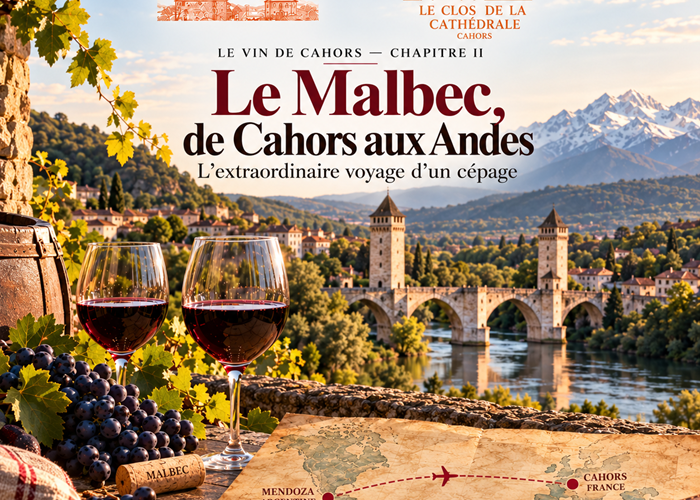
CAHORS WINE — CHAPTER II
Malbec, from Cahors to the Andes
The extraordinary journey of a grape variety
There are wines that tell the story of a land. Others that tell a story. Malbec, however, tells both. And its story is something extraordinary: deeply rooted in the landscapes of Cahors, it crossed the Atlantic to become, thousands of kilometers from its historical birthplace, the emblem of an entire country: Argentina.
How did a grape variety so closely linked to Quercy manage to conquer the vineyards of Mendoza, at the foot of the Andes Mountains? And why, nearly two centuries later, do the Malbecs of Cahors continue to rival the finest expressions of this grape variety in the world?
This is the story of a journey, of an encounter between two terroirs and of a passion that knows no borders.
In Cahors, a grape variety with deep roots
Long before it was called Malbec, this black grape was known by other names.
In the Quercy region, it is traditionally called Auxerrois . Elsewhere, particularly in the Loire Valley, it is known as Côt . Three names for the same grape variety, now recognized worldwide as Malbec.
Around Cahors, the vine has accompanied the lives of people for centuries and shaped the landscapes. The limestone hillsides, the terraces of the Lot valley and the variations in soil offer Malbec particularly favorable conditions.
It produces wines with a deep, sometimes almost black, color, with aromas of blackberry, blackcurrant, plum and violet. With time, some develop notes of spice, undergrowth or truffle.
This intense color has largely contributed to the historical reputation of the famous "black wine of Cahors" .
But the destiny of Malbec was not to be limited to the banks of the Lot.
1853: A Frenchman brings Malbec to Argentina
In the mid-19th century, Argentina sought to modernize its agriculture and develop its viticulture.
A French agronomist, Michel Aimé Pouget, based in South America, then played a decisive role.
In 1853, he participated in the creation of an agricultural school in Mendoza and introduced several French grape varieties, including Malbec.
April 17, 1853 became a symbolic date in this adventure. Today, it is celebrated every year as World Malbec Day.
At the time, no one imagined that this grape from France would become one of the most famous ambassadors of Argentinian wines.
And yet, Malbec finds a second home in Mendoza.
At the foot of the Andes, the days are generously sunny, the nights can be cool and the climate is much drier than in the Southwest of France.
The vineyards, often located at high altitudes, benefit from significant temperature variations. Water from the mountains irrigates the land in this naturally arid region.
Malbec adapts remarkably well to it.
Over the decades, it has become the emblematic grape variety of Argentina, to the point that many enthusiasts around the world now spontaneously associate it with that country.
An astonishing twist of fate for this grape from Quercy!
Two continents, one grape, two personalities
Tasting a Malbec from Cahors followed by an Argentinian Malbec is a particularly interesting experience.
Because even if the grape variety is the same, the wines tell significantly different stories.
In Cahors , Malbec often expresses a beautiful structure, present tannins, a certain freshness and an aromatic depth that gives it a remarkable aging potential.
Depending on the terroir and the winemaker's work, it can be powerful, elegant, fruity or delicately spicy.
In Argentina , particularly in the Mendoza region, Malbecs frequently offer more generous expressions, with ripe black fruits, a full texture and often supple tannins.
Of course, each region has a great diversity of terroirs and styles. Some Argentinian Malbecs are taut and delicate, while some Cahors seduce with their roundness and immediate fruitiness.
That's precisely what makes the comparison so fascinating.
Malbec did not change its identity by crossing the ocean: it learned to speak with a different accent.
2024: A winemaker from Cahors recognized on the international stage
The history of Malbec is not only written in the past. It continues today thanks to passionate winemakers, deeply attached to their land and determined to have the quality of Cahors wines recognized.
In February 2024, Bertrand-Gabriel Vigouroux , head of the Châteaux de Haute-Serre and de Mercuès, was awarded the international prize "Best Malbec" , presented at the Master Winemakers Awards organized by the British magazine The Drinks Business .
A great recognition for a winemaker from Cahors, the historical birthplace of this grape variety which has become world-famous.
But behind this success lies a family story.
Among the emblematic wines of Château de Haute-Serre is "Georges" , created in homage to his father, Georges Vigouroux, who had undertaken in 1971 to revive this historic vineyard.
This vintage itself was awarded a gold medal at the Global Malbec Masters 2023 , confirming the quality and expertise of this family estate.
From father to son, the Vigouroux family has thus contributed to the revival and influence of Cahors wines, while defending the identity of their emblematic grape variety.
A nice twist of fate: while Argentina gave Malbec a global reputation, a winemaker from Cahors is seeing his work recognized on the international stage.
A beautiful way to remember that Malbec, despite its extraordinary journey to the foot of the Andes, retains deep roots in the lands of Quercy.
Cahors, a wine of character that also knows how to surprise
Today, the Cahors protected designation of origin is based on a strong identity: its wines are exclusively red and must be made with at least 70% Malbec .
Merlot and Tannat can complete the blend, but many winemakers also choose to produce cuvées made entirely from Malbec.
The appellation, recognized in 1971, has been undergoing a tremendous renewal for several decades.
New generations of winemakers are exploring the nuances of the terroirs, working on balances, refining aging techniques and offering wines that are sometimes very far removed from the traditional image of powerful and austere Cahors.
We thus discover Malbecs that are fresh, delicious and approachable in their youth, but also great wines for aging that can gain in complexity over many years.
The Cahors vineyard possesses this rare wealth: it knows how to remain true to its history while reinventing itself.
What if we discovered Malbec through a tasting?
To understand this extraordinary journey, nothing beats a simple experience: to bring together around the same table a Malbec from Cahors and a Malbec from Mendoza.
Two bottles, two terroirs, one single grape variety.
Start by observing the colors, then take the time to discover the aromas. Do dark fruits dominate? Do you perceive floral, spicy, or woody notes?
On the palate, compare the freshness, structure, tannin texture and length of the wines.
It is not about declaring a winner, but about understanding how climate, soils and the winemaker's choices can transform the expression of the same grape.
To accompany this tasting, the specialties of Quercy offer great possibilities: duck breast, Quercy lamb, stews or mature cheeses.
Malbec is also a wonderful conversational companion.
And perhaps that is one of its finest qualities.
Discover the Cahors vineyard, getting as close as possible to its roots
While Argentina has given Malbec a worldwide reputation, it is around Cahors that one can discover an essential part of its history.
A few kilometers from the city, the roads wind between stone villages, vineyards, hillsides and landscapes of the Lot valley.
Many estates open their doors to visitors to share their craft, explain their terroirs and showcase their vintages.
From the Château de Haute-Serre to the estates of the Lot valley, each encounter offers another way to understand Cahors wine.
From Le Clos de la Fontaine, in Labastide-Marnhac , or Le Clos de la Cathédrale, in the heart of Cahors , the vineyard lends itself wonderfully to a gourmet getaway.
A visit to the estate, a tasting, a lunch featuring local produce or a walk in the Quercy landscapes: so many ways to extend the discovery.
Because behind every bottle of Malbec, there is much more than just wine.
There is a land, people, choices, traditions and sometimes even a journey of several thousand kilometers.
Malbec has conquered the world. But to understand its full history, we must also go back to Cahors.
#Malbec, #vin_de_Cahors, #histoire_du_Malbec, #Malbec_Argentine, #Mendoza, #vignoble_de_Cahors, #vin_noir_de_Cahors, #cépage_Côt, #Auxerrois, #terroir_du_Quercy, #vins_du_Lot, #Bertrand-Gabriel_Vigouroux, #Château_de_Haute-Serre, #cuvée_Georges, #Michel_Aimé_Pouget, #dégustation_de_Malbec, #œnotourisme_Cahors, #route_des_vins_de_Cahors, #Le_Clos_de_la_Fontaine, #Le_Clos_de_la_Cathédrale
image
The History of the Way of St. James - Chapter 2
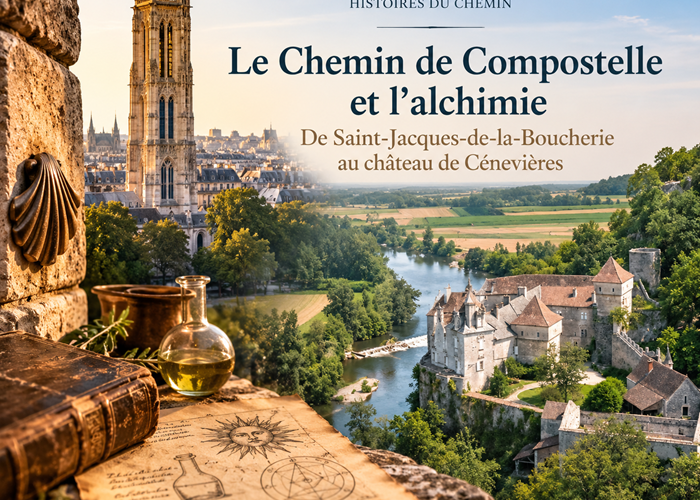
Stories from the Way – Chapter 2
The Way of St. James and Alchemy
From Saint-Jacques-de-la-Boucherie to the castle of Cénevières
Behind the grand history of the Way of St. James, there are more secret paths.
Since the Middle Ages, millions of pilgrims have made the journey to Galicia. They walked to pray at the tomb attributed to the apostle James, to fulfill a vow, to ask for forgiveness, or simply to search for something they could no longer find at home.
But over the centuries, the Way has also become laden with more mysterious stories, symbols, and traditions.
Among them is an astonishing encounter between the pilgrimage to Compostela and alchemy .
And our story begins in Paris.
Saint-Jacques-de-la-Boucherie: why leave from here?
In the Middle Ages, Paris was an important crossroads for travelers coming from northern and eastern Europe.
On the right bank stands the church of Saint-Jacques-de-la-Boucherie . Its name simply comes from the Grande Boucherie district and the powerful butchers' guild that contributes to its upkeep.
But his patron saint is indeed Saint James the Greater .
The church possesses relics attributed to the apostle and naturally maintains links with the confraternities and pilgrims of Saint James. Paris thus becomes one of the places where walkers can meet before continuing on to Tours, Poitiers, Bordeaux and then the Pyrenees.
This is the axis that we know today as the Via Turonensis .
Between 1509 and 1523, a spectacular flamboyant Gothic bell tower was built next to the church.
The church disappeared after the Revolution. Sold as national property in 1797, it was gradually demolished.
Its bell tower, however, will be saved.
This is the Saint-Jacques Tower that we know today.
And the story could end there.
But a man who actually frequented Saint-Jacques-de-la-Boucherie will take our story into a very different universe.
Nicolas Flamel: History meets legend
Nicolas Flamel really existed.
A public scribe and Parisian bourgeois of the 14th and 15th centuries, he lived near Saint-Jacques-de-la-Boucherie, participated in the financing of religious works and was buried in this church upon his death in 1418.
However, there is no historical evidence to suggest that Nicolas Flamel was an alchemist .
This reputation appeared after his death and gradually grew to considerable proportions. In alchemical accounts, Flamel then became the possessor of a mysterious manuscript attributed to "Abraham the Jew," whose enigmatic figures he supposedly sought to understand.
And this is where the legend meets our Path.
According to this later tradition, Flamel undertook a journey to Santiago de Compostela in order to obtain the knowledge necessary to decipher the manuscript.
The Parisian bourgeois disappears behind his legendary double: Flamel the alchemist .
The pilgrimage, a test for the alchemist?
We are now voluntarily leaving behind documented history.
For an esoteric tradition goes even further: the apprentice alchemist should have completed the Camino de Santiago to Compostela, then returned to his starting point. And he should have undertaken this journey in winter.
The idea is fascinating.
But no sufficiently solid medieval historical source allows us today to present this "obligation" as a practice actually imposed on apprentice alchemists.
We are therefore in the realm of initiatory tradition, and not in that of History .
Nevertheless, the symbolism is particularly powerful.
In the Hermetic tradition, the alchemist does not merely seek to transform one substance into another. The Great Work is also interpreted as a transformation of the one who accomplishes it.
So what does the pilgrim do?
He leaves his home. He abandons some of the superfluous things. He faces fatigue, loneliness, cold, uncertainty. And he moves forward, day after day.
Winter then takes on a special meaning: nature seems to die before being reborn; The light dims before returning.
And the round trip also takes on its full meaning.
Reaching Compostela would not be enough.
We should come back.
Returning home after the ordeal and resuming one's place in the world, but different from the person who left.
This is a very beautiful reading of the pilgrimage.
But it remains a symbolic reading.
A few hundred kilometers further south…
Let's leave Paris now.
The Way descends towards the southwest. Other routes gradually join the vast network of the Way of St. James.
And much closer to Cahors, in the Lot valley, a spectacular castle appears overlooking the river: the castle of Cénevières .
We are here close to the geographical area traversed by pilgrims taking the Célé variant , which joins the Lot valley before continuing towards Saint-Cirq-Lapopie and Cahors.
And this time, alchemy is no longer just a legend.
Cénevières: when alchemy leaves traces
The medieval castle of Cénevières was profoundly transformed during the Renaissance.
Among the preserved items is an extraordinary alchemy cabinet , officially identified as such by the General Inventory of Cultural Heritage.
Its monumental paintings, symbols, and decor constitute an exceptional testimony. Some scenes are notably inspired by Ovid's Metamorphoses .
And the word seems almost to have been chosen for our story:
Metamorphoses.
Because we find this idea of transformation which accompanies both the alchemical imagination and the initiatory reading of the pilgrimage.
But let us beware of crossing a border.
There is no evidence to suggest that the alchemy cabinet in Cénevières had any connection with the pilgrims of Saint James or that it was established here because of the proximity of a pilgrimage route to Santiago.
The proximity exists. The historical link, however, has not been proven.
And ultimately, that's perhaps what makes the story even more beautiful.
The Historical Share
The church of Saint-Jacques-de-la-Boucherie did indeed exist in Paris and was dedicated to Saint James. It possessed relics attributed to the apostle and was linked to the world of pilgrims. Its bell tower, completed at the beginning of the 16th century, is the present-day Saint-Jacques Tower .
Nicolas Flamel did indeed live nearby, was a benefactor of the parish and was buried there in 1418. However, his activity as an alchemist is not attested by the sources of his time.
Finally, the Château de Cénevières , in the Lot, actually preserves an alchemy cabinet whose decorations are studied and protected as heritage.
The element of legend
The mysterious manuscript of Nicolas Flamel, his initiation into the secrets of transmutation and his journey to Compostela belong to a tradition elaborated after his death.
Even more mysterious is the claim that the apprentice alchemist should have completed the Camino de Santiago there and back, in winter .
We have not found a sufficiently reliable historical source to make it a rule actually observed by alchemists.
Finally, no known document establishes a link between the alchemy cabinet of Cénevières and the pilgrimage to Saint-Jacques.
And yet…
In Paris, one of the most famous figures of the alchemical legend rests in a church dedicated to Saint James.
In the Lot, near the world of paths leading pilgrims to Cahors, a castle still preserves the very real traces of the alchemy of the Renaissance.
The story ends there.
The legend, however, can continue.
To leave, to search… and to return transformed
#Chemin_de_Compostelle, #Saint-Jacques-de-Compostelle, #alchimie, #histoire_de_l’alchimie, #pèlerinage_et_alchimie, #Nicolas_Flamel, #Tour_Saint-Jacques, #Saint-Jacques-de-la-Boucherie, #Paris_médiéval, #château_de_Cénevières, #cabinet_d’alchimie_de_Cénevières, #Grand_Œuvre_alchimique, #symbolique_du_pèlerinage, #traditions_initiatiques, #légendes_de_Compostelle, #histoire_et_légendes_du_Chemin, #voie_du_Célé, #GR651, #patrimoine_du_Lot, #Cahors, #Quercy
image